The Maintenance Rule (10 CFR 50.65) in Maximo
🎯 Who this is for: Reliability and engineering leads who own the maintenance basis — and who need to know, before they write a statement of work, exactly which parts of the Maintenance Rule Maximo ships as an application and which parts they have to configure.
Series: Part 4 of 7 — Maximo for Nuclear on MAS 9 | Read time: 17 minutes
🚫 The Honest Part
Every series has one part where the honest answer is more valuable than the impressive one. For Maximo Nuclear, this is it.
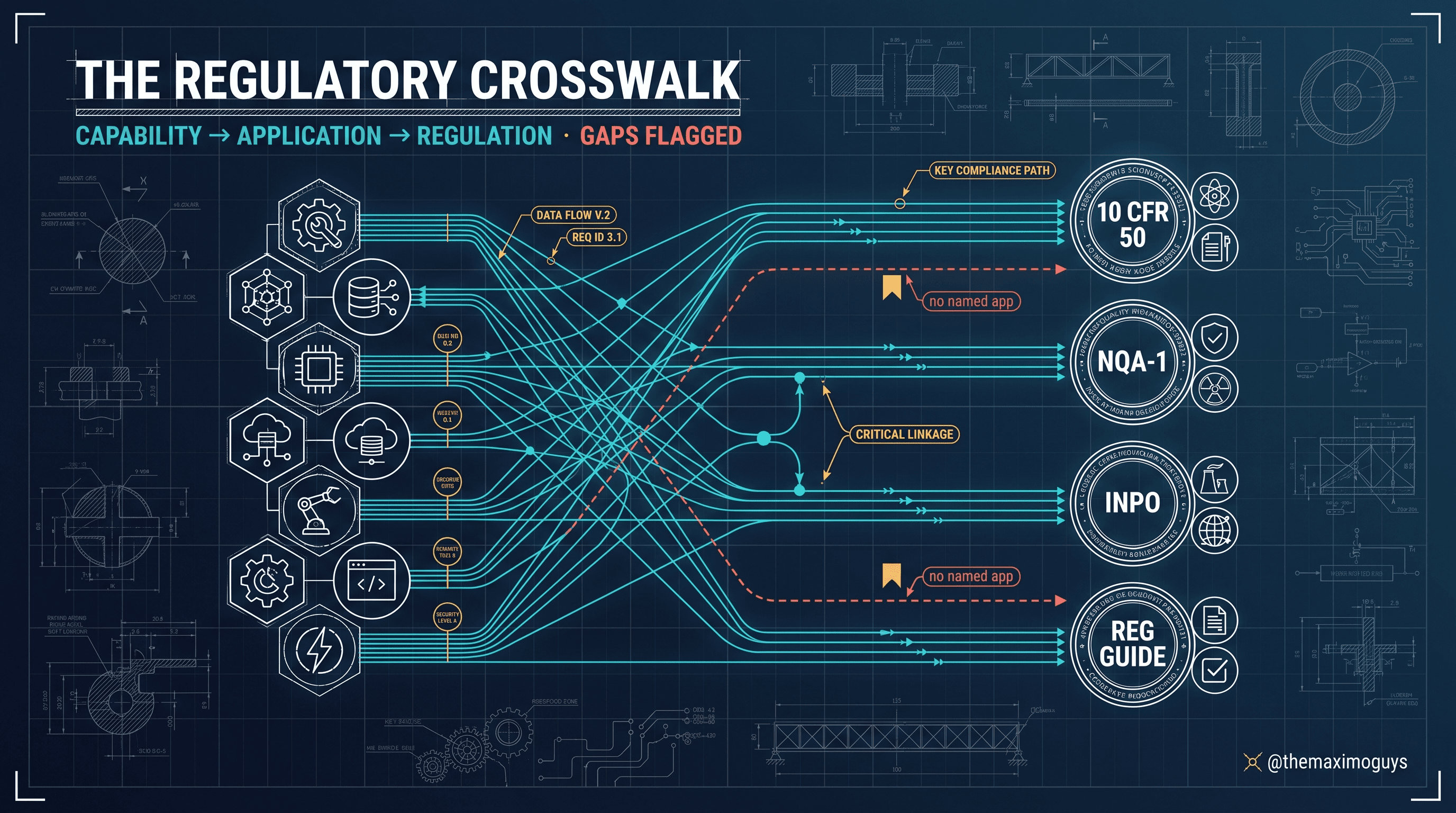
There is no application called "Maintenance Rule" in Maximo Nuclear. If you go looking for a 10 CFR 50.65 module in the app list, you will not find one. This is a documented reality, not an oversight, and it is precisely the kind of thing an analyst deck or an over-eager demo will paper over — implying an app exists that does not.
We do the opposite. We name what is real, name what is configured, and explain the pattern so you can scope it correctly. Because here is the thing: the capability is entirely real and entirely deliverable. It just arrives as a configuration pattern across several applications, not as a button labeled "Maintenance Rule."
<aside>
💡 Key insight: "No named app" is not the same as "not supported." The Maintenance Rule is one of a small set of capabilities — alongside AP-913 scoping, hold points, OPEX, and nuclear e-signature — that Maximo delivers through configuration of existing applications. That is an industry-standard, defensible approach. What is not defensible is claiming a shipped Maintenance Rule application. The difference between those two statements is the difference between a clean audit and an awkward one.
</aside>
📏 What the Rule Requires
To see why the pattern works, hold the shape of the rule in mind. 10 CFR 50.65 — the Maintenance Rule — requires licensees to monitor the effectiveness of maintenance on scoped structures, systems, and components (SSCs). Its familiar two-branch structure:
- (a)(2): For SSCs whose performance is being effectively controlled by preventive maintenance, monitor performance or condition against established goals. This is the "steady-state" branch — most scoped SSCs live here.
- (a)(1): For SSCs that are not being effectively controlled — where performance has slipped past its criterion — set goals and take corrective action to restore effective control, monitoring against those goals until effectiveness is demonstrated.
There are two more branches worth naming because they shape the evidence Maximo must supply:
- (a)(3): Periodically evaluate the monitoring program's effectiveness and adjust as needed (the program-level review).
- (a)(4): Before performing maintenance, assess and manage the risk introduced by the maintenance activity (the online-risk / configuration-risk assessment).
The rule is fundamentally about scoping, performance criteria, monitoring, failure history, goal-setting, corrective action, and pre-maintenance risk assessment — and every one of those maps to a Maximo capability. That is why the configuration pattern is not a workaround; it is a natural fit.
The vocabulary that makes the evidence make sense
Two terms recur and are worth pinning down, because they determine what counts:
- A functional failure (FF) is a failure of an SSC to perform its intended function.
- A maintenance-preventable functional failure (MPFF) is a functional failure that better maintenance could have prevented. The (a)(2) performance criteria are usually written against MPFFs, not all failures — which means the coding of a failure (was it maintenance-preventable?) directly drives whether a criterion is exceeded.
That distinction is why failure coding, not just failure counting, is the load-bearing capability.
🛠️ How 10 CFR 50.65 Is Actually Implemented
The Maintenance Rule is implemented in Maximo through a pattern of four cooperating capabilities:
| Capability | What it contributes to the Rule |
|---|---|
| Assets (Nuc) | Nuclear-extended asset lifecycle with safety-related / augmented-quality flags and the critical-component flag, plus system/train/component hierarchy — the scoped-SSC backbone |
| Failure codes | Consistent performance and failure coding on work orders, including the maintenance-preventable distinction — the raw material of the (a)(2) criteria |
| Condition Monitoring | Measurement points and condition data for performance/condition monitoring under (a)(2) |
| Maximo Health | Asset health scoring and risk-based prioritization — surfacing where effective control is slipping toward (a)(1) |
How the four cooperate
The flow is coherent. Assets (Nuc) defines and flags the scoped population, carrying the safety-related and critical-component flags that mark what falls under the Rule, and the system/train/component hierarchy that lets you monitor at the right level (function, train, or component). Failure codes turn work-order history into consistent, analyzable failure data — and crucially let you distinguish an MPFF from a non-preventable failure, which is what the (a)(2) criterion is written against. Condition Monitoring supplies the performance-and-condition signal (vibration, pressure, temperature) that (a)(2) monitoring depends on when the criterion is condition-based rather than failure-count-based. And Maximo Health scores asset health, helping surface the assets where performance is no longer being effectively controlled — the (a)(1) candidates that need goals and corrective action.
<aside>
💡 Key insight: Read that table as an answer to a specific audit question. When an evaluator asks "how do you monitor Maintenance Rule effectiveness and demonstrate it?", the answer is a set of records — flagged assets, coded failure history, condition-monitoring trends, health scores — assembled from these applications, not a single Maintenance Rule report generated by a Maintenance Rule app. Maximo is the system of record that supplies the evidence. The effectiveness judgment — the (a)(1)/(a)(2) determination — is a program decision your engineers make with that evidence.
</aside>
This is the boundary line worth internalizing for the whole series: Maximo supplies evidence; it does not make the compliance judgment. That is not a limitation to apologize for — it is the correct division of labor. A regulator wants a human program owner accountable for the effectiveness determination, backed by a defensible record. Maximo builds the record.
🧩 A Worked Example: A Service Water Pump Slips to (a)(1)
Watch the pattern operate on one component. The Rule mechanics (MPFF counting, performance criteria, the (a)(2)→(a)(1) transition) are genuine Maintenance Rule practice; the identifiers and numbers are illustrative.
The scoped SSC. Service Water Pump SWP-1B is an Assets (Nuc) record flagged safety-related and critical-component, positioned in the system/train hierarchy under the Service Water system, Train B. It is monitored at the component level under (a)(2) with a performance criterion: no more than 2 maintenance-preventable functional failures in a rolling 24-month window, and discharge pressure maintained within its acceptance band.
The monitoring. Discharge pressure and bearing vibration are Condition Monitoring measurement points, trended continuously. Every corrective work order against SWP-1B is coded with failure codes that record problem/cause/remedy and, critically, whether the failure was maintenance-preventable. Maximo Health rolls the failure history and condition trends into a health score.
The slip. Over eighteen months, SWP-1B logs its third MPFF — a coupling failure that a revised lubrication interval would have prevented, coded as maintenance-preventable. That third MPFF breaches the "no more than 2 in 24 months" criterion. Maximo did not decide anything; it supplied the coded record that shows the criterion is exceeded. The reliability engineer makes the call: SWP-1B moves to (a)(1).
The (a)(1) response. Under (a)(1), the program sets a goal (illustratively: zero MPFFs for the next 12 months, discharge pressure within band) and takes corrective action — a revised PM (Nuc) task with a shortened lubrication interval and a coupling upgrade tracked as a Condition Report and follow-up work order (the CAP loop, Part 5). Monitoring continues against the (a)(1) goal, with the health score and failure coding as the evidence.
Return to (a)(2). Twelve months later, SWP-1B has logged zero MPFFs and held pressure in band. The engineer, backed by the record, returns it to (a)(2). The whole transition — criterion, breach, (a)(1) goals, corrective action, effectiveness, return — is an evidenced trail across Assets (Nuc), failure codes, Condition Monitoring, PM (Nuc), Maximo Health, and the CAP.
<aside>
💡 Key insight: Nothing in that example required a "Maintenance Rule" screen, and everything in it is auditable. The (a)(2)→(a)(1)→(a)(2) transition is exactly the kind of thing an NRC inspector or an INPO evaluator traces, and the trail is a set of connected records — not a report from a module. That is the honest, defensible shape of "Maximo does the Maintenance Rule": it supplies every piece of evidence the determination rests on, and your engineer owns the determination.
</aside>
🔬 AP-913 Rides the Same Pattern
INPO's AP-913 equipment reliability process is the industry framework that operationalizes the maintenance basis, and it is tightly related to the Maintenance Rule. The natural question is whether Maximo ships an AP-913 module.
The honest answer, again: AP-913 equipment scoping is a partial capability with no named app. It is implemented via classifications, the critical-component flag, and Reliability Strategies.
- Classifications structure the equipment taxonomy that AP-913 scoping depends on.
- The critical-component flag on Assets (Nuc) marks the critical population — the heart of AP-913 scoping.
- Reliability Strategies provides the FMEA-driven maintenance-basis capability that AP-913 uses to define and justify the maintenance approach for scoped equipment.
The AP-913 component categories, and where they live
AP-913 sorts equipment into reliability categories that drive how much maintenance attention each component earns. The categories are domain practice; Maximo carries them as configuration, not as a named AP-913 field:
| AP-913 category | Meaning | Maximo configuration home |
|---|---|---|
| Critical | Failure prevents a system safety/production function; heavy PM basis | Critical-component flag + classification + tailored PM (Nuc) strategy |
| Non-critical | Monitored but lighter maintenance basis | Classification + condition-based monitoring |
| Run-to-maintenance / run-to-failure | Failure is acceptable; corrective on failure | Classification; minimal PM, corrective work only |
The scoping decision — which category a component belongs in — is an engineering judgment. Maximo holds the result (the flag, the classification, the PM strategy), supplies the failure and condition history that informs re-categorization, and executes the resulting maintenance basis. It does not make the categorization for you.
<aside>
💡 Key insight: AP-913 is the second big "configuration, not app" story, and the pattern rhymes with the Maintenance Rule. The critical-component flag and classifications do the scoping; Reliability Strategies does the FMEA and maintenance-basis work; the reliability program owner makes the calls. Scoping an AP-913 implementation means configuring that pattern — and, crucially, saying it is a configuration pattern in the SOW rather than promising an "AP-913 module" that does not exist.
</aside>
🤖 What Reliability Strategies Actually Adds
Reliability Strategies deserves its own section because it is a genuinely useful MAS platform capability that nuclear inherits, and it is where the 9.x AI wave touches maintenance-basis work.
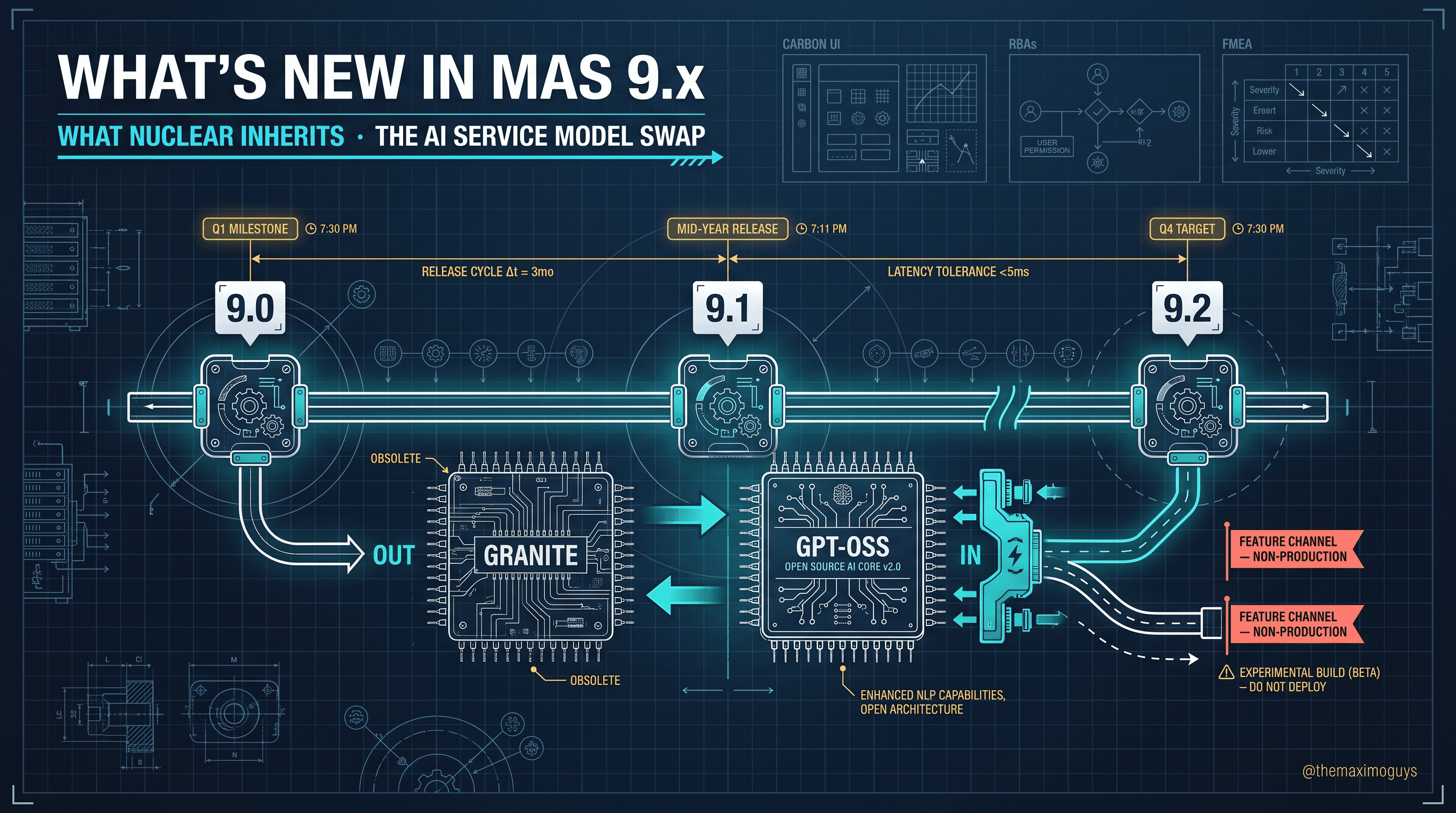
Introduced in MAS 9.0 and enhanced in 9.1, Reliability Strategies provides FMEA management with a large failure-mode library — the source material cites a library on the order of tens of thousands of failure modes across hundreds of asset types — and supports custom strategies. For AP-913 basis work, that is real leverage: instead of building every FMEA from a blank page, an engineer starts from a library entry for the asset type and tailors it. The FMEA Content Builder added in 9.1 can generate FMEA content with AI assistance, and the AI Service (Part 7) underpins failure-mode alignment and cause classification.
The honest framing: Reliability Strategies accelerates the maintenance-basis and FMEA work AP-913 requires; it does not replace the engineer's judgment about scope or category. It is a platform capability, not a nuclear-only feature — nuclear inherits it as a Manage industry solution runs on top of the platform. Part 7 covers the 9.2-era AI Service model change (Granite → GPT-OSS-120B) that touches these functions.
<aside>
💡 Key insight: When a stakeholder asks "what does MAS 9 AI do for our reliability program?", the grounded answer is precise: it accelerates FMEA and failure-mode work through Reliability Strategies and FMEA Content Builder, and it surfaces recurrence through Similarity Tracker. Those are real, inherited platform capabilities — not a nuclear-exclusive AI feature set, and not a substitute for the AP-913 categorization judgment your engineers own.
</aside>
📖 What NRC Reg Guide 1.160 Expects
The NRC guidance for the Maintenance Rule is Regulatory Guide 1.160 (Rev 3) — the guidance on monitoring the effectiveness of maintenance at nuclear power plants. It sets out the expectations for how a licensee scopes SSCs, sets performance criteria, monitors, and takes corrective action under 10 CFR 50.65.
Maximo's role against that guidance is exactly the evidence-supply role described above. Reg Guide 1.160 expects a program — scoping, criteria, monitoring, corrective action, periodic effectiveness evaluation ((a)(3)), and pre-maintenance risk assessment ((a)(4)). Maximo supplies the data layer that program runs on:
- The scoped SSC population (Assets (Nuc), classifications, critical-component flag)
- The performance and failure history (failure codes with the MPFF distinction, work orders, Condition Monitoring)
- The health and risk view (Maximo Health)
- The corrective actions when performance slips (which flow through the Corrective Action Program — Part 5)
<aside>
💡 Key insight: Notice how this part hands off to Part 5. When (a)(1) is triggered and corrective action is required, that corrective action does not live in a Maintenance Rule app — it lives in the Corrective Action Program, run by Condition Reports (Nuc). The Maintenance Rule pattern and the CAP engine are two halves of the same reliability loop: monitoring surfaces the problem, the CAP tracks the fix. Part 5 picks up exactly there.
</aside>
🗂️ A Field-and-Evidence Reference
Where each Maintenance Rule obligation resolves to a Maximo record — an illustrative map you can hand to an inspector:
| 50.65 obligation | Maximo evidence | Record home |
|---|---|---|
| Scoping | Safety-related / critical-component flags, classifications | Assets (Nuc) |
| (a)(2) performance criteria | MPFF-coded failure history vs criterion | Failure codes on work orders |
| (a)(2) condition monitoring | Trended measurement points vs limits | Condition Monitoring |
| Effective-control status | Health score, risk view | Maximo Health |
| (a)(1) goals + corrective action | Condition Report + follow-up WOs + revised PM | Condition Reports (Nuc), PM (Nuc) |
| (a)(3) program review | Aggregated performance reporting | KPIs / reporting |
| (a)(4) pre-maintenance risk | Operability/impact modeling before work | Impact Plans (Nuc) (Part 3) |
⚠️ Edge Cases That Bite
- MPFF versus functional failure. If failure coding does not distinguish maintenance-preventable failures, the (a)(2) criterion becomes unmeasurable — every failure counts equally, and the criterion is either always breached or never breached. The MPFF flag is not optional; it is the criterion's denominator.
- Wrong monitoring level. The Rule allows monitoring at the plant, system, train, or component level. Monitor too high and a failing component hides in an aggregate; too low and you drown in noise. The Assets (Nuc) hierarchy must support monitoring at the level the program chose.
- Risk-significant scoping. Scoping is not just "safety-related." The Rule reaches non-safety SSCs whose failure could prevent a safety function or cause a scram/transient. A scoping model that only follows the safety-related flag under-scopes the program.
- (a)(4) is a separate obligation. Pre-maintenance risk assessment is easy to forget because it is not about long-term monitoring. It lives in the operability/impact-modeling territory (Impact Plans), not the failure-history territory — do not let it fall through the gap between "monitoring" and "work control."
- Goal-setting without a return criterion. An (a)(1) component with a goal but no defined return-to-(a)(2) criterion never comes back. Configure both the goal and the effectiveness criterion that ends (a)(1).
🔧 Troubleshooting the Maintenance-Rule Pattern
| Symptom | Likely cause | What to do |
|---|---|---|
| (a)(2) criteria can never be evaluated | Failures not coded maintenance-preventable | Add the MPFF distinction to failure coding; train coders on it |
| A failing component never triggers (a)(1) | Monitoring level too high (hidden in aggregate) | Monitor at the level the criterion is written for; use the Assets hierarchy |
| An (a)(1) component never returns to (a)(2) | No return/effectiveness criterion defined | Define the return criterion when the (a)(1) goal is set |
| Non-safety risk-significant SSCs are outside the program | Scoping keyed only on safety-related flag | Extend scoping to risk-significant SSCs via classification, not just the flag |
| (a)(4) risk assessments are not evidenced | Pre-maintenance risk not modeled | Use Impact Plans (Nuc) to record the pre-maintenance operability/risk check |
✍️ Scoping This Honestly
For the reliability lead writing or reviewing a statement of work, the discipline is simple and it protects you:
- Name the pattern, not a phantom app. "10 CFR 50.65 monitoring is delivered through Assets (Nuc), failure codes (with the MPFF distinction), Condition Monitoring, and Maximo Health, configured to our scoped population" is accurate. "Maximo's Maintenance Rule module handles 50.65" is not.
- Do the same for AP-913. "AP-913 scoping uses classifications, the critical-component flag, and Reliability Strategies" is accurate. "Maximo ships an AP-913 module" is not.
- Cover all four branches. Name (a)(1), (a)(2), (a)(3), and (a)(4) explicitly — and put (a)(4) in the impact/operability territory so it is not lost.
- Keep the judgment with your engineers. Maximo supplies the evidence; the effectiveness determination and the AP-913 categorization are human program decisions. That is what a regulator expects, and it keeps accountability where it belongs.
Get those sentences right and you have scoped the single most over-claimed capability in nuclear EAM correctly — which is worth more, in an audit, than any feature you could have oversold.
Key Takeaways
- There is no application named "Maintenance Rule" in Maximo Nuclear — 10 CFR 50.65 is a configuration pattern, and the series says so plainly.
- The pattern is Assets (Nuc) + failure codes (with the MPFF distinction) + Condition Monitoring + Maximo Health for the (a)(1)/(a)(2) monitoring loop, with (a)(4) risk assessment sitting in Impact Plans.
- AP-913 equipment scoping also has no named app — it uses classifications, the critical-component flag, and Reliability Strategies, with the Critical / Non-critical / Run-to-failure categories held as configuration.
- Reliability Strategies (FMEA management with a large failure-mode library, FMEA Content Builder, AI-assisted thresholds) is a MAS 9.0/9.1 platform capability nuclear inherits.
- NRC Reg Guide 1.160 Rev 3 is the guidance; Maximo supplies the evidence a Maintenance Rule program needs — it does not automate the compliance judgment.
References
- 10 CFR 50.65 — Requirements for monitoring the effectiveness of maintenance (NRC)
- NRC Regulatory Guide 1.160 Rev 3 (NRC)
- 10 CFR 50.65 — Maintenance effectiveness regulations and guidance (NRC)
- IBM Maximo for Nuclear Power — Continuous Delivery overview (IBM Documentation)
- INPO AP-913 equipment reliability context (OSTI)
Series Navigation
| Previous: | Part 3 — Configuration Control & Nuclear Work Packages |
|---|---|
| Next: | Part 5 — Corrective Action Program & Clearance/Tagout |
About TheMaximoGuys: We help Maximo developers and teams navigate the move to MAS 9 with practical, no-hype guidance grounded in how the platform actually behaves.
Published by TheMaximoGuys | July 2026
 Venkat Achanta