watsonx.data vs. Databricks vs. MAS Native: Choosing the IBM-Native Path (and Governing It)
🎯 Who this is for: IT and platform owners weighing watsonx.data against Databricks (or against doing neither), architects who need a defensible, caveated comparison instead of a vendor slide, and governance and compliance leads who need to know exactly how Maximo's own security model carries — or doesn't — into an Iceberg lakehouse.
Series: Part 6 of 6 (Series Finale) — MAS 9 + IBM watsonx.data: Building the Maximo Open Lakehouse | Read time: 19 minutes
📖 The Question This Post Actually Answers
Five parts in, this series has made an IBM-native case: an open Iceberg lakehouse, fit-for-purpose engines that share one copy of the data, and watsonx.ai turning Gold-layer features into predictions, RAG answers, and Maximo write-backs. None of that is worth much without an honest answer to the question every one of those parts deferred: why watsonx.data instead of Databricks, and how do you actually govern either one once Maximo's own security model stops traveling with the data?
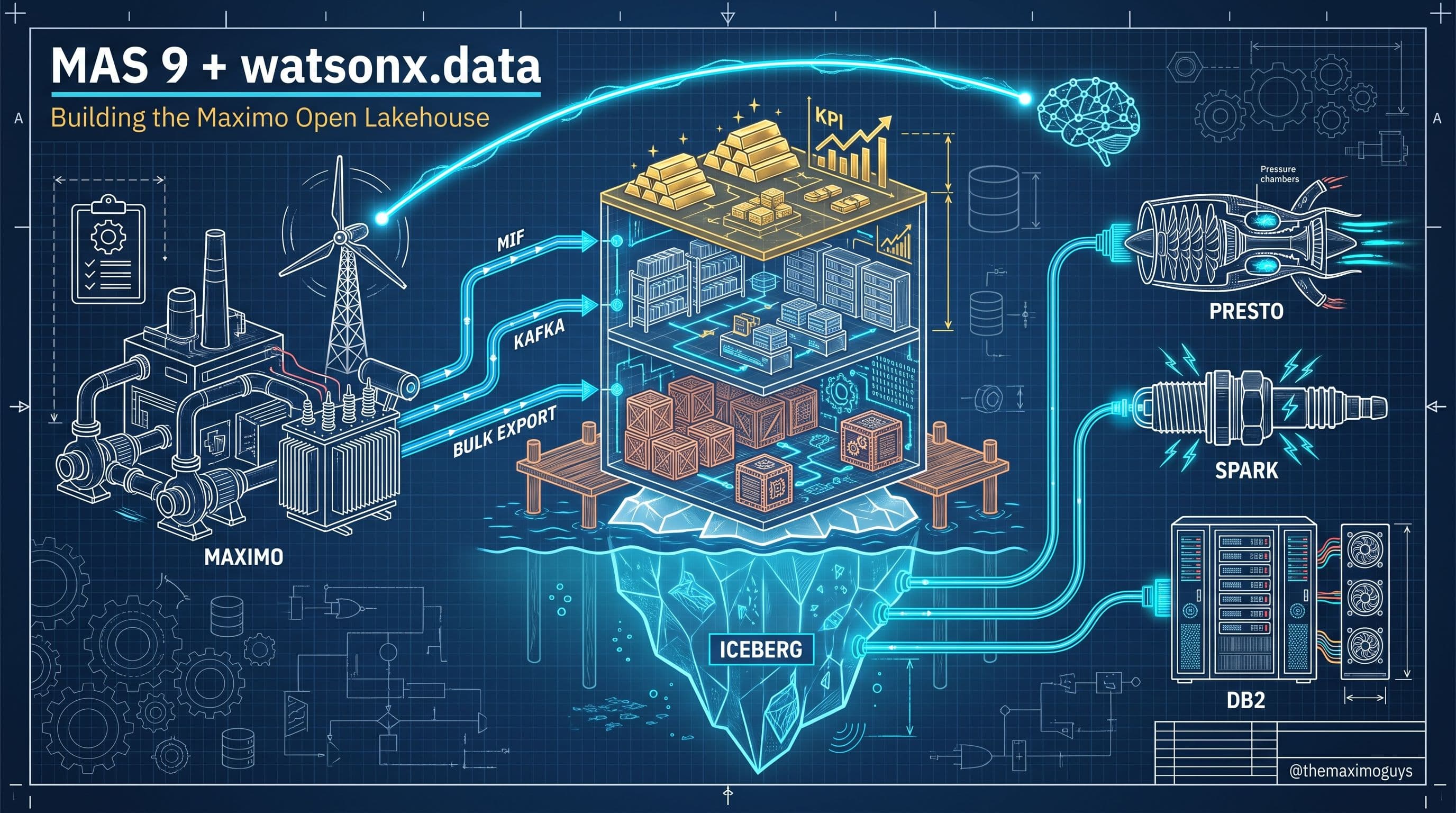
This post answers both halves. The first half is the head-to-head this series' index promised from Part 1 — Apache Iceberg against Delta Lake, Presto C++/Velox against Photon, IBM Knowledge Catalog (renamed IBM watsonx.data intelligence in May 2025; the IKC name persists across IBM docs, so this post keeps it) against Unity Catalog, Milvus/OpenRAG against Databricks' vector search — with IBM's own benchmark claims labeled as exactly that, IBM's own benchmark claims, every time they come up. The second half is the governance work an IBM-native choice still owes you: mapping Maximo's Security Groups and Data Restrictions onto IKC or Apache Ranger policies, a worked LABTRANS masking example, and how watsonx.governance closes the loop on the models and RAG pipelines Part 5 built.
💡 Key insight: A platform comparison that only compares features is marketing with extra steps. This one names where IBM's numbers come from, where the benchmarks aren't apples-to-apples, and where "it depends on what you already run" is the real answer — because that's what actually survives a procurement review.
⚖️ watsonx.data vs. Databricks: The Honest Head-to-Head
Apache Iceberg vs. Delta Lake
Both are open table formats solving the same underlying problem — ACID transactions, schema evolution, and time travel on top of plain Parquet files — and both are genuinely open-source, which makes this less of an "open vs. closed" argument than marketing on either side sometimes implies. The real difference is architectural posture. watsonx.data standardizes on Apache Iceberg as its primary, default table format, and every fit-for-purpose engine in Part 4 — Presto, Presto C++/Velox, Spark, Db2 Warehouse, Netezza — reads the same Iceberg tables without a copy or a translation layer. Databricks pairs Delta Lake with Photon, its own proprietary vectorized execution engine; Delta itself is an open format, but the fastest, most-optimized path through it runs on Databricks' runtime specifically.
Neither format locks you out of the other entirely. watsonx.data can zero-copy federate to Databricks' Unity Catalog, and Presto can query Uniform-enabled Delta tables through the Iceberg REST Catalog API — Delta Lake's Universal Format (Uniform) writes Iceberg-compatible metadata alongside the native Delta log specifically to enable this. A hybrid "Delta in Databricks, Iceberg in watsonx.data" architecture is technically feasible for an organization mid-migration between the two, but it is not automatic: every governance policy has to be reconciled across both catalogs by hand, a cost the FAQ above names directly.
| Dimension | Apache Iceberg (watsonx.data) | Delta Lake (Databricks) |
|---|---|---|
| Governing project | Apache Software Foundation, multi-vendor contributors | Linux Foundation, Databricks-led |
| Multi-engine reads | Native across Presto, Spark, Db2, Netezza, and external engines | Native in Databricks; cross-engine via Uniform/Delta Sharing |
| Runtime coupling | Table format decoupled from any one execution engine | Delta + Photon is the fastest path; other engines read Delta but not at Photon speed |
| Time travel / snapshots | Iceberg snapshot isolation | Delta transaction log versioning |
| Maximo-relevant win | A WORKORDER attribute change absorbs cleanly across every reading engine without a per-engine schema fix | Deep, mature integration with Databricks' own MLflow/Mosaic AI tooling |
Presto C++/Velox vs. Photon
This is the execution-engine half of the same bet, and it's where IBM's headline cost claim lives. Presto C++, built on the open-source Velox library (a C++ native acceleration layer designed to be composable across compute engines — Meta and IBM are both contributors), is Presto's move from a JVM-based engine to native code, chasing the same 3-4x performance ceiling that Photon and Apache DataFusion are chasing from their own starting points. Photon is Databricks' proprietary vectorized engine, tightly integrated with Delta and the rest of the Databricks runtime.
IBM's own published benchmark states Presto C++/Velox delivers equal query runtime at less than 60% the cost of Photon, based on a 100 TB TPC-DS workload. Read the infrastructure details before repeating that number in a business case: IBM's test ran Presto C++ v0.286 on 1 master plus 75 worker nodes (1,009 vCPUs, 18 TB memory) on newer Intel Sapphire Rapids hardware; the Databricks side of the comparison is Databricks' own publicly published 2021 100 TB TPC-DS results on 1 master plus 256 worker nodes (2,112 vCPUs, 16.1 TB memory) — a different node count, a different hardware generation, five years apart. That gap doesn't mean the claim is wrong; it means it's an IBM-run comparison against a public but dated baseline, not a live, symmetric bake-off, and IBM's own documentation discloses the setup rather than hiding it.
IBM'S BENCHMARK SETUP                          DATABRICKS' PUBLISHED BASELINE
─────────────────────────────                  ──────────────────────────────
Presto C++ v0.286                               Photon (2021 published results)
1 master + 75 workers                           1 master + 256 workers
1,009 vCPUs / 18 TB memory                      2,112 vCPUs / 16.1 TB memory
Intel Sapphire Rapids (current-gen)             2021-era hardware baseline
100 TB TPC-DS                                   100 TB TPC-DS
                    ↓                                        ↓
        "< 60% the cost of Photon at equal runtime" — IBM's own framing
Directionally credible. Not a symmetric, independently-run bake-off.| Dimension | Presto C++ / Velox | Photon |
|---|---|---|
| Ownership | Open-source (PrestoDB Foundation, IBM/Meta contributors) | Proprietary, Databricks-only |
| Target workload | Interactive SQL, cost-sensitive high-performance analytics | Databricks-native SQL and DataFrame workloads |
| Runs on | Any watsonx.data-attached engine over Iceberg | Databricks runtime over Delta |
| IBM's cost claim | "<60% the cost of Photon at equal runtime" (IBM benchmark, 100 TB TPC-DS) | — |
| Caveat | Benchmarked against Databricks' own dated public results, not a live symmetric test | Databricks' own published TPC-DS baseline is from 2021 |
💡 Key insight: "IBM benchmarks say X" is not the same claim as "X is independently verified." This series has repeated that caveat in every part that touches the Presto C++/Photon comparison, and it's worth repeating one final time at the finale: run your own proof-of-concept on your own query mix before either number goes in front of a budget committee.
IBM Knowledge Catalog vs. Unity Catalog
Governance is the dimension where the two platforms' philosophies diverge most visibly. Unity Catalog is Databricks-centric — a single, deeply integrated governance layer built specifically for the Databricks runtime, with row filters and column masks implemented as SQL user-defined functions bound to a table. watsonx.data takes a pluggable stance: its Common Policy Gateway (CPG) is a lightweight, downloadable interface that lets IBM Knowledge Catalog, Apache Ranger, or Collibra all serve as the policy engine, selectable per deployment rather than fixed to one vendor's tool. When IKC is the selected engine, it governs data across every Presto catalog and enforces its policies at query execution time, regardless of which fit-for-purpose engine issued the query.
That flexibility comes with a decision to make, not a free pass. IKC ties natively into watsonx.governance's model lineage and is the lowest-friction default for a shop with no existing policy-engine investment. Apache Ranger is the right call for a shop already running it elsewhere — reusing that investment instead of introducing IBM-specific tooling — but Ranger's column masking has a documented gap: it does not support integer or bigint column types, which matters directly the moment a masking policy needs to touch a numeric Maximo field like reorderpoint, laborcost, or a Part 5 RUL model's failure-probability score.
| Dimension | IBM Knowledge Catalog (or Ranger via CPG) | Unity Catalog |
|---|---|---|
| Architecture | Pluggable policy engine (IKC, Ranger, or Collibra) via Common Policy Gateway | Single, native Databricks-integrated catalog |
| Enforcement point | At query execution, consistently across Presto, Spark, Db2 | At query execution, within the Databricks runtime |
| Masking mechanism | Data protection rules: Redact, Substitute, Obfuscate | Row filters and column masks as SQL UDFs |
| Vendor flexibility | Bring your own policy engine, avoid lock-in | Databricks-native by design |
| AI governance tie-in | Native link to watsonx.governance (lineage, AI Factsheets) | Native link to Databricks' Mosaic AI governance |
| Known limitation | Ranger column masking doesn't support integer/bigint types | Row filter/column mask logic must be hand-written per table (no built-in OR-combination rule) |
Milvus/OpenRAG vs. Databricks Vector Search
Part 5 covered watsonx.data's RAG stack in depth; the comparison worth naming here is the vector-retrieval layer specifically. watsonx.data's embedded Milvus vector database — built on FAISS, ANNOY, and HNSW-family libraries — is designed for similarity search across datasets running into the billions of vectors, paired with OpenSearch for hybrid keyword-plus-semantic retrieval and OpenRAG (Docling + Langflow) for the document-conversion and orchestration layers Part 5 walked in detail. Databricks Mosaic AI Vector Search (formerly Databricks Vector Search) is built natively into the Databricks Data Intelligence Platform, uses HNSW for approximate nearest-neighbor search with an L2 distance metric, and — like watsonx.data's OpenSearch layer — supports hybrid keyword-plus-vector retrieval rather than pure vector similarity alone.
Functionally, both stacks solve the same RAG-retrieval problem competently; the meaningful difference is integration surface, not raw capability. Milvus/OpenRAG is the natural choice when the rest of your pipeline already lives in watsonx.data and you want retrieval, governance, and the Iceberg tables under one platform; Mosaic AI Vector Search is the natural choice for a team already building on Databricks' MLflow and Unity-Catalog-governed feature store, where the vector index inherits the same access controls as everything else in the workspace.
🧭 The Decision Framework
Collapsing the head-to-head into a call you can actually make. This is the same three-way framing Part 1 and the series index opened with, scored explicitly instead of left as a gut call.
| Signal | Weight Toward |
|---|---|
| You're IBM-standardized (Maximo, Cognos, watsonx.ai via AI Service, Red Hat OpenShift) and want one support/licensing path | watsonx.data |
| You want an open table format with no single-vendor runtime coupling for future flexibility | watsonx.data |
| Cost control via engine choice (RU metering, right-sizing Presto vs. Presto C++ vs. Spark) matters more than raw peak throughput | watsonx.data |
| Your RAG corpus is manuals + WO text and fits the Docling/Milvus/OpenRAG pattern | watsonx.data |
| You need the deepest, most mature managed-MLOps ecosystem (MLflow, Mosaic AI, the widest third-party integration catalog) | Databricks |
| You're already running production workloads on the Databricks runtime elsewhere in the business | Databricks |
| Your data science team already has deep Photon/Spark-on-Databricks tuning expertise | Databricks |
| The actual pain is Cognos's 3-author-seat limit, Predict's fixed catalog ceiling, or Monitor's retention window — not a missing lakehouse | Stay MAS-native |
| You need Health scoring, Monitor real-time alerting, Predict quick-start models, or Assistant Q&A on Maximo-only data | Stay MAS-native |
| Nobody on the team can commit to owning either platform's governance layer long-term | Stay MAS-native, revisit later |
Score your own environment against this table honestly before a vendor conversation starts, not during one. Most mixed answers point toward watsonx.data specifically when the "IBM-standardized" and "cost control via engine choice" rows both hit — that combination is where an IBM-native shop's existing footprint does the most work for the least incremental spend.
              ┌─────────────────────────────────────┐
              │   Have you hit a NAMED MAS 9 ceiling? │
              └───────────────────┬───────────────────┘
                        NO        │        YES
                         ▼        │         ▼
              ┌──────────────┐    │   ┌─────────────────────────┐
              │ Stay MAS-native│   │   │ IBM-standardized shop?   │
              │ (Part 1's      │   │   └──────────┬──────────────┘
              │  diagnostic)   │   │      YES      │      NO
              └──────────────┘    │       ▼        │       ▼
                                  │  ┌──────────┐   │  ┌───────────────┐
                                  │  │watsonx.data│  │  │ Databricks     │
                                  │  │            │   │  │ runtime already │
                                  │  └──────────┘   │  │ invested / need  │
                                  │                 │  │ deepest MLOps    │
                                  │                 │  └───────────────┘
💡 Key insight: "Which lakehouse" is the second question, always. The first question — asked identically at the top of this series' Part 1, the MAS-DATABRICKS series' Part 1, and again right here at the finale — is whether you've actually hit a named MAS 9 ceiling. Skipping that step is the single most common overspend pattern in lakehouse projects touching an EAM system, regardless of which platform gets picked next.
🔐 Governing the Lakehouse: Mapping Maximo Security to IKC and Ranger
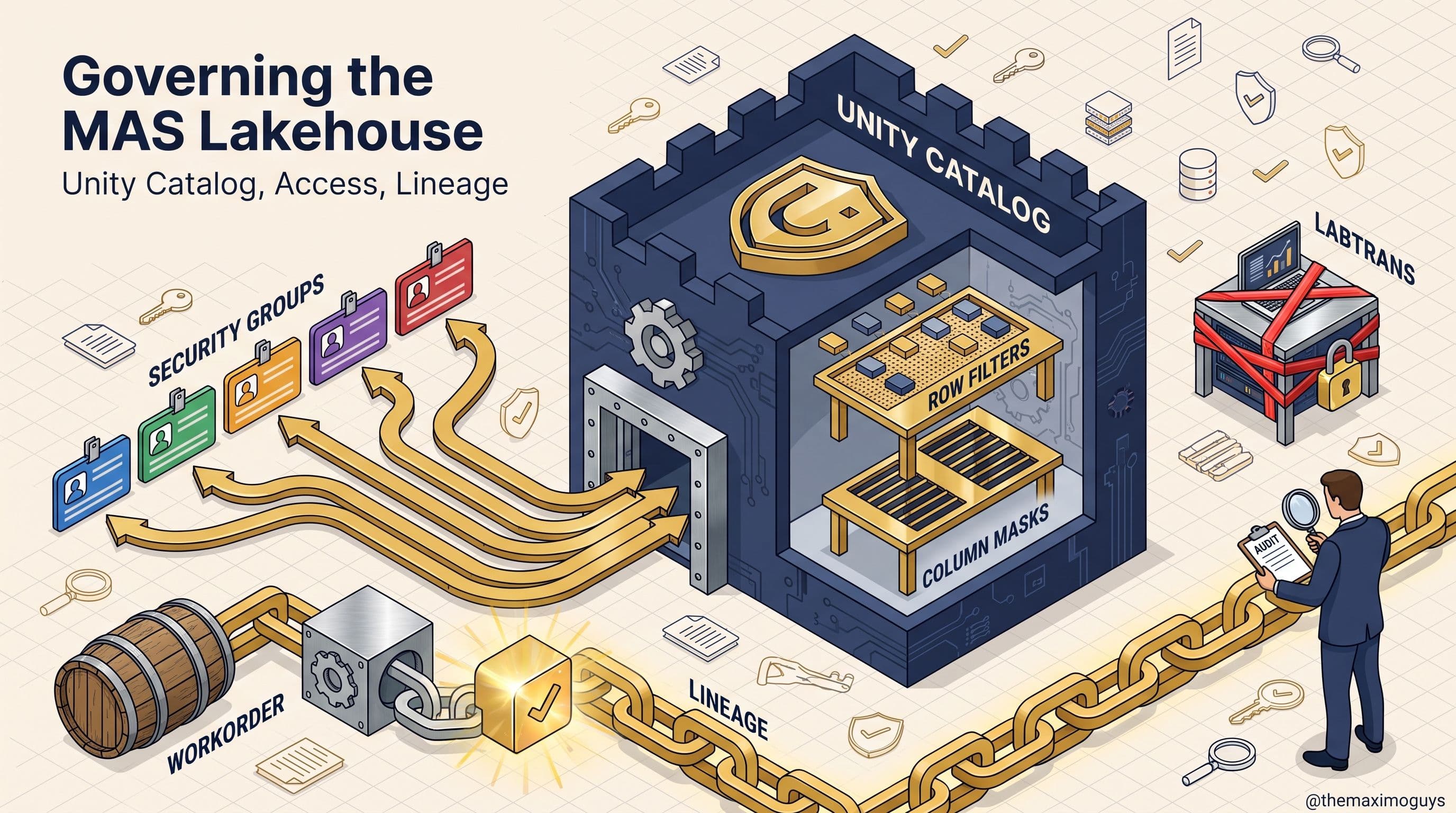
Everything above assumes the platform decision is made. None of it matters if the governance layer isn't built, because a lakehouse inherits nothing from Maximo's own authorization model by default — not automatically, not partially, not by any mechanism short of someone deliberately rebuilding it. The moment a WORKORDER record crosses the MIF REST extraction Part 2 built, the JSON payload carries field values. It does not carry the security group that restricted who could see them inside Manage.
Maximo's own security model is built around Security Groups, configured with a specific sequence: authorize sites on the Sites tab, authorize applications and access types on the Applications tab, authorize object structure APIs for external sharing, authorize storeroom/labor/GL component access, and — the tab that matters most here — the Data Restrictions tab, where conditional expressions restrict access to objects, attributes, and collections per record (a documented example: an attribute restricted to be read-only whenever :orgid = 'EAGLENA'). When a user belongs to multiple security groups, Maximo's combination rule is an explicit OR: the union of what each group individually restricts applies to the combined authorization, not the intersection.
| Maximo Security Groups Tab | What It Controls in Manage | IKC / Ranger Equivalent |
|---|---|---|
| Sites | Which sites/orgs a user or group can see records for | Data protection rule scoped to a siteid/orgid column, or a Ranger row-level policy keyed the same way |
| Applications | Which applications and access types (read/save/delete) a user is granted | Catalog-level grants on the Presto catalog or schema exposing that data downstream |
| Object Structures | Which object structure APIs external integrations can reach | Grants on the specific Iceberg tables/views a downstream system or BI tool is allowed to query |
| Storerooms / Labor / GL Components | Sub-application access to inventory, labor, or general ledger data | Column-level data protection rules (masking) on the specific columns carrying that data |
| Data Restrictions (Expression Manager) | Conditional expressions making an object/attribute read-only or hidden per record | IKC data protection rules (row/column) or Ranger row-level filters and column masking policies |
| OR-combination across multiple groups | Union of restrictions applies when a user is in more than one group | No automatic combination rule in IKC/Ranger by default — each policy has to be written to account for overlapping group membership explicitly |
That last row deserves the same caution the MAS-DATABRICKS series' governance finale gives Unity Catalog: this mapping is a starting vocabulary for translating a Maximo administrator's mental model into lakehouse terms, not a migration script. Maximo's Data Restrictions apply inside one system with one authorization model; a lakehouse aggregates Maximo data alongside ERP, weather, and sensor sources into flat Iceberg tables where "who can see this" has to be re-derived per column, not inherited from the source.
💡 Key insight: watsonx.data's Common Policy Gateway is what makes this mapping portable — the same Data Restrictions vocabulary translates whether the policy engine on the other end is IKC, Ranger, or (per IBM's own framing) Collibra. Pick the engine based on what your organization already operates, not because one is architecturally superior for Maximo data specifically; none of the three has a Maximo-specific advantage here.
🎭 Worked Example: Masking LABTRANS Pay-Rate Data
Taking the mapping from vocabulary to something you can actually configure, against the same tables this series has built throughout: silver.WORKORDER_FACT joins in labor data from LABTRANS, which means it carries hours worked and the pay-rate-derived labor cost per work order — routine maintenance history sitting next to genuine compensation data. A reliability analyst querying work order duration and count has no legitimate need to see the underlying pay-rate math.
watsonx.data's IKC-backed data protection rules support three masking methods, applied once in the catalog and enforced consistently regardless of which engine issues the query — Presto, Spark, or a connected Db2 Warehouse instance all see the same masked result:
| Masking Method | What It Does | Fits This Use Case When |
|---|---|---|
| Redact | Replaces every character with a fixed character (commonly X) | The value must be fully hidden, not just obscured — a raw pay rate for an analyst role with no compensation-viewing authorization |
| Substitute | Replaces the value with data that doesn't match the original format | A downstream system needs a value in the field (for join compatibility) but never the real one |
| Obfuscate | Replaces the value with a similarly-formatted but different value | Preserves realistic-looking data for testing/demo environments without exposing real figures |
-- Illustrative IKC data protection rule against watsonx.data's
-- silver.WORKORDER_FACT, masking the LABTRANS-derived labor cost column
-- for any role without the LABOR_COST_VIEWER classification.

-- 1. Classify the sensitive column (done in IKC's catalog UI or API)
--    Column: silver.WORKORDER_FACT.LABORCOST
--    Data class: "Compensation Data"

-- 2. Data protection rule (masking action)
--    Criteria: Data Class = "Compensation Data"
--    Method: Redact
--    Exempt: role = LABOR_COST_VIEWER (planners, payroll integration service accounts)

-- Enforcement is identical regardless of the querying engine:
SELECT wonum, siteid, assetnum, status, laborcost
FROM iceberg.silver.workorder_fact
WHERE siteid = 'BEDFORD';

-- Analyst without LABOR_COST_VIEWER sees:
--   wonum   | siteid  | assetnum | status | laborcost
--   WO-4471 | BEDFORD | P-4471   | INPRG  | XXXXXXXX

-- Planner with LABOR_COST_VIEWER sees the real value unmasked.
The rule is defined once, against the column, in the catalog — not once per engine, not once per dashboard. That's the concrete payoff of IKC (or Ranger) governing "all data in Presto catalogs," as DOC13 frames it: a Cognos-replacement BI tool connecting through Db2 Warehouse, a data scientist's notebook querying through Spark, and an ad-hoc Presto SQL session all see the same masked laborcost column without three separate masking implementations to keep in sync.
⚠️ Common pitfall: Masking a column doesn't retroactively protect data already copied into a gold-layer aggregate built before the rule existed. Ifgold.maintenance_cost_summarywas built from unmaskedsilver.WORKORDER_FACTbefore a LABTRANS masking policy went live, that gold table needs to be rebuilt from the now-governed silver source, not assumed safe because the source column is masked going forward.
🧬 watsonx.governance: Closing the Loop on Every Model This Series Built
Part 5 produced real artifacts: custom PdM/RUL models trained on Gold-layer features, RAG pipelines over maintenance manuals, and write-back automations creating work orders. Every one of those is exactly what watsonx.governance — IBM's "enterprise AI assurance layer," recognized as a Leader in the 2026 Gartner Magic Quadrant for AI Governance platforms — is built to track.
- Governance Graph — a living map connecting AI assets to policies, risks, and regulatory requirements across environments, so a Part 5 RUL model isn't a standalone artifact nobody else can find.
- AI Factsheets — IBM's own framing calls these "nutrition labels" for models: automatically logged creation data, training datasets, performance metrics, deployment context, lifecycle status, and version history, generated without a human manually maintaining a spreadsheet.
- Model inventory dashboard — a consolidated view of every tracked asset, including third-party or open-weight models (relevant directly to Part 5's Granite-vs-gpt-oss-120b routing question, since both need to be inventoried regardless of which one is currently serving a feature).
- Watson OpenScale monitors — accuracy and fairness tracking for classical ML (a custom RUL model), and PII/toxicity/groundedness guardrails for GenAI (the RAG troubleshooting agent Part 5 walked end to end), plus drift evaluation so a model trained on last year's failure patterns gets flagged before it silently degrades.
- OpenPages Model Risk Governance — GRC workflows and risk-assessment scoring integrated with the Governance Graph, the piece that turns "we have a model" into "we can show a risk committee we assessed the model."
Maximo relevance, concretely: every FMEA recommender, similarity classifier, and Assistant prompt AI Service already runs can be registered in watsonx.governance for Factsheet documentation and OpenScale monitoring; a custom Part 5 RUL model gets the same lineage trail back to the MEASUREMENT_FACT and FAILURE_FACT tables it trained against; and a RAG troubleshooting agent gets a guardrail ensuring it never recommends deferring safety-critical maintenance past a defined limit — the specific governance case a maintenance organization has to get right before trusting AI output next to live equipment.
| Governance Layer | What It Covers | Answers Which Audit Question |
|---|---|---|
| IKC / Ranger (data) | Row/column policies on Iceberg tables — who can query what | "Who was authorized to see the data behind this score?" |
| watsonx.governance (AI) | Model lineage, Factsheets, OpenScale drift/fairness/groundedness | "What model produced this score, on what data, and is it still valid?" |
| Closed-loop write-back (Part 5) | The REST call or AI Service action that turned a score into a Maximo action | "What action did this score actually trigger, and who approved it?" |
Stack all three and a lakehouse-derived recommendation is defensible end to end: provenance from IKC/Ranger's access logs, model validity from watsonx.governance's Factsheets and drift monitors, and the action itself from Part 5's write-back audit trail. Missing any one of the three is exactly the gap an auditor asking "who authorized this maintenance decision" will find first.
🗺️ Closing the Series: A Rollout Checklist
Six parts in, the pattern that should feel repetitive by now is the point: name the native ceiling, extend past it deliberately, close the loop back into Maximo, govern what you built. A practical order for actually doing it:
- Run Part 1's diagnostic before any platform conversation. If the gap is under-used MAS 9 entitlement — Cognos seats, Predict's catalog, Monitor's retention window — fix that first; it's cheaper than any lakehouse.
- Score the decision framework above honestly, weighted by your actual IBM-standardization level and existing platform investments, not by which vendor pitched last.
- Stand up IKC or Ranger governance in Phase 1, not Phase 5. DOC13's own implementation roadmap places governance hardening in the foundation phase alongside the first Bronze extract — retrofitting masking after a gold table is already in three dashboards is materially harder than building it in from the start.
- Run the LABTRANS PII review before the first silver-layer build, not after a compliance request. Any table joining labor data or carrying free-text long descriptions gets the review before promotion to gold.
- Register every Part 5 model and RAG pipeline in watsonx.governance as it's built, not retroactively — Factsheets generated at creation time are complete; Factsheets backfilled months later rely on someone's memory of what training data was actually used.
- Revisit the decision framework annually. A "stay MAS-native" answer today is a data point, not a permanent conclusion — Predict's catalog grows, Cognos licensing changes, and the ceiling that didn't exist last year may exist now.
💡 Key insight: The series' last word is the same as its first: a lakehouse — watsonx.data, Databricks, or anything else — earns its cost only past a real, nameable ceiling, and it only pays back when its output closes the loop back into a Maximo action a technician or planner actually sees. Everything in between — Iceberg vs. Delta, IKC vs. Unity Catalog, Milvus vs. Mosaic AI — is implementation detail in service of that one requirement.
Key Takeaways
- Iceberg vs. Delta and Presto C++/Velox vs. Photon are legitimate, close competitions, not a rout — Iceberg trades some Databricks-native tooling maturity for genuine multi-engine openness, and IBM's "<60% the cost of Photon" claim is credible but was benchmarked against Databricks' own dated public results on different infrastructure, not a live symmetric test.
- IBM Knowledge Catalog and Apache Ranger both plug into watsonx.data via the Common Policy Gateway — pick based on existing tooling investment, not a claimed Maximo-specific advantage, and check Ranger's integer/bigint column-masking gap against your actual numeric fields before committing to it.
- Maximo's Security Groups tabs — Sites, Applications, Object Structures, Storerooms/Labor/GL, Data Restrictions — map directly onto IKC/Ranger row and column policies, the same way they map onto Unity Catalog on the Databricks side, with data protection rules (Redact, Substitute, Obfuscate) as the concrete masking mechanism.
- LABTRANS pay-rate data is the sharpest PII case in a Maximo-fed lakehouse, but free-text work order descriptions and custom asset fields carry the same risk — review any table joining LABTRANS or long-description columns before it's promoted past silver.
- The three-way decision — watsonx.data, Databricks, or stay MAS-native — should be scored, not assumed, and watsonx.governance's Factsheets, lineage, and OpenScale monitors are what make every model and RAG pipeline this series built defensible in front of an auditor, not just impressive in a demo.
References
- IBM watsonx.data — Superior price-performance and enhanced data management announcement
- Accelerating query performance with watsonx.data Presto C++ and Intel Sapphire Rapids on AWS — IBM
- Enabling Apache Ranger policy resources — IBM watsonx.data documentation
- Masking data (Watson Knowledge Catalog) — IBM Cloud Pak for Data as a Service documentation
- IBM watsonx.data intelligence legacy service plans (documents the May 2025 rename from IBM Knowledge Catalog) — IBM Cloud Pak for Data as a Service
- IBM watsonx.governance product page
- IBM watsonx.data's integrated vector database — unify, prepare, and deliver your data for AI
- What's new in Maximo Application Suite 9.1 — IBM Documentation
- DOC13: IBM watsonx.data + Maximo Roadmap — §4.4 (Governance: IKC & watsonx.governance), §7.1-7.3 (Head-to-Head, Decision Framework, Complementary Architecture) (internal knowledge base,
knowledge_base/DOC13_IBM_WATSONX_DATA_MAXIMO_ROADMAP.md) - DOC14: The IBM watsonx Platform: A Field Guide for Maximo Teams — §7 (watsonx.governance) (internal knowledge base,
knowledge_base/DOC14_IBM_WATSONX_PLATFORM_FIELD_GUIDE.md) - Maximo Manage documentation — Creating security groups, Data Restrictions tab (internal knowledge base,
maximo_manage_Section_163_Creating_security_groups.md,maximo_manage_Section_165_About_this_task.md)
Series Navigation
| Previous: | Part 5 — From Lakehouse to Action |
|---|---|
| Series Index: | MAS 9 + IBM watsonx.data: Building the Maximo Open Lakehouse |
About TheMaximoGuys: We help Maximo developers and teams navigate the move to MAS 9 with practical, no-hype guidance grounded in how the platform actually behaves.
Published by TheMaximoGuys | July 2026

 Surendra Katta