

Autocomplete → Chat → Agents: The Three Eras of AI Coding
🎯 Who this is for: Anyone trying to understand why "AI coding" means something very different in 2026 than it did in 2022, and what that means for the systems your business runs on.
Series: Part 3 of 13 — Enterprise Vibe Coding | Read time: 6 minutes
Imagine the same maintenance planner at a water utility asking for help on three different days.
2022: A developer writes a report query. As he types SELECT wonum, status FROM, a grey suggestion appears and finishes the line. Nice. Saves him ten seconds.
2024: He opens a chat window and asks, "How do I find overdue work orders grouped by site?" He gets a decent answer, copies it, fixes the table names by hand, and pastes it in. Saves him twenty minutes.
2026: He types, "Find every high-priority work order that's been waiting on parts for more than two weeks, group them by site, and draft a note for each site supervisor." The agent plans the steps, calls the work management system through its API, checks the results, and drafts the notes. It pauses before sending anything and asks him to approve.
Same person, same goal. Three completely different relationships with the AI. Let's walk through them.
⌨️ Era 1: Autocomplete
The first wave of AI coding lived inside the editor and worked one line at a time. GitHub Copilot made it mainstream: you type, it guesses the rest, you press Tab.
Autocomplete was low-risk and easy to approve. It only ever touched the line you were looking at, and you saw every character before accepting it. For enterprises that made it an easy first step. Security teams worried about code leaving the building, but nobody worried about the AI quietly changing ten files.
The limit was obvious: it knew almost nothing beyond the file in front of it.
💬 Era 2: Chat
Next came the chat window. You could ask questions in plain English, paste in an error, or request a whole function. Every tool added one, from Copilot Chat to Cursor to the general-purpose assistants people kept open in a browser tab.
Chat made AI useful to people who were not fluent in a language yet, and it made explaining old code much easier. But the human was still the courier. You copied context in and copied answers out. The AI could not see your repository, run your tests or check your systems. Every answer was a well-informed guess.
🤖 Era 3: Agents
Agents removed the copy-paste. An agent can read your whole project, write a plan, edit many files, run commands and tests, and call outside tools, looping until the job is done. Claude Code runs in the terminal; Cursor, Copilot and Kiro all have agent modes; IBM Bob's V2 release in June 2026 settled on three modes (Agent, Plan and Ask), with subagents and parallel tool calls for bigger jobs.
The shift is from suggesting to doing, and that is why governance suddenly matters. In Bob V2, for example, reading files is auto-approved, but edits, commands and external tool calls still need a human to approve them. Most agent tools follow a similar pattern.
| Autocomplete | Chat | Agents | |
|---|---|---|---|
| What it does | Finishes your line | Answers your question | Plans and carries out a task |
| What it can see | The current file | What you paste in | Your repo, terminal and connected systems |
| Who moves the code | You press Tab | You copy and paste | The agent, with your approval |
| Typical risk | A bad suggestion | A wrong answer | A wrong action |
| Main enterprise question | Is our code leaving the building? | Is the answer correct? | What is it allowed to touch? |
🔌 MCP: How Agents Reach Your Systems
An agent that can only see your code is still half blind. The interesting work in an enterprise lives in other systems: the ticketing tool, the asset register, the customer database, the document store.
Before late 2024, every AI tool needed a custom connector for every system. Anthropic called this an "N×M" problem. In November 2024 it introduced the Model Context Protocol (MCP), an open standard that works a bit like a USB-C port for AI. You build one MCP server for a system, describing the tools it offers ("search work orders," "get asset history"), and any MCP-capable agent can use it. OpenAI, Microsoft and AWS adopted it, and the project now sits under the Linux Foundation. IBM Bob reads its MCP setup from a .bob/mcp.json file; Claude Code, Cursor and Copilot have their own equivalents.
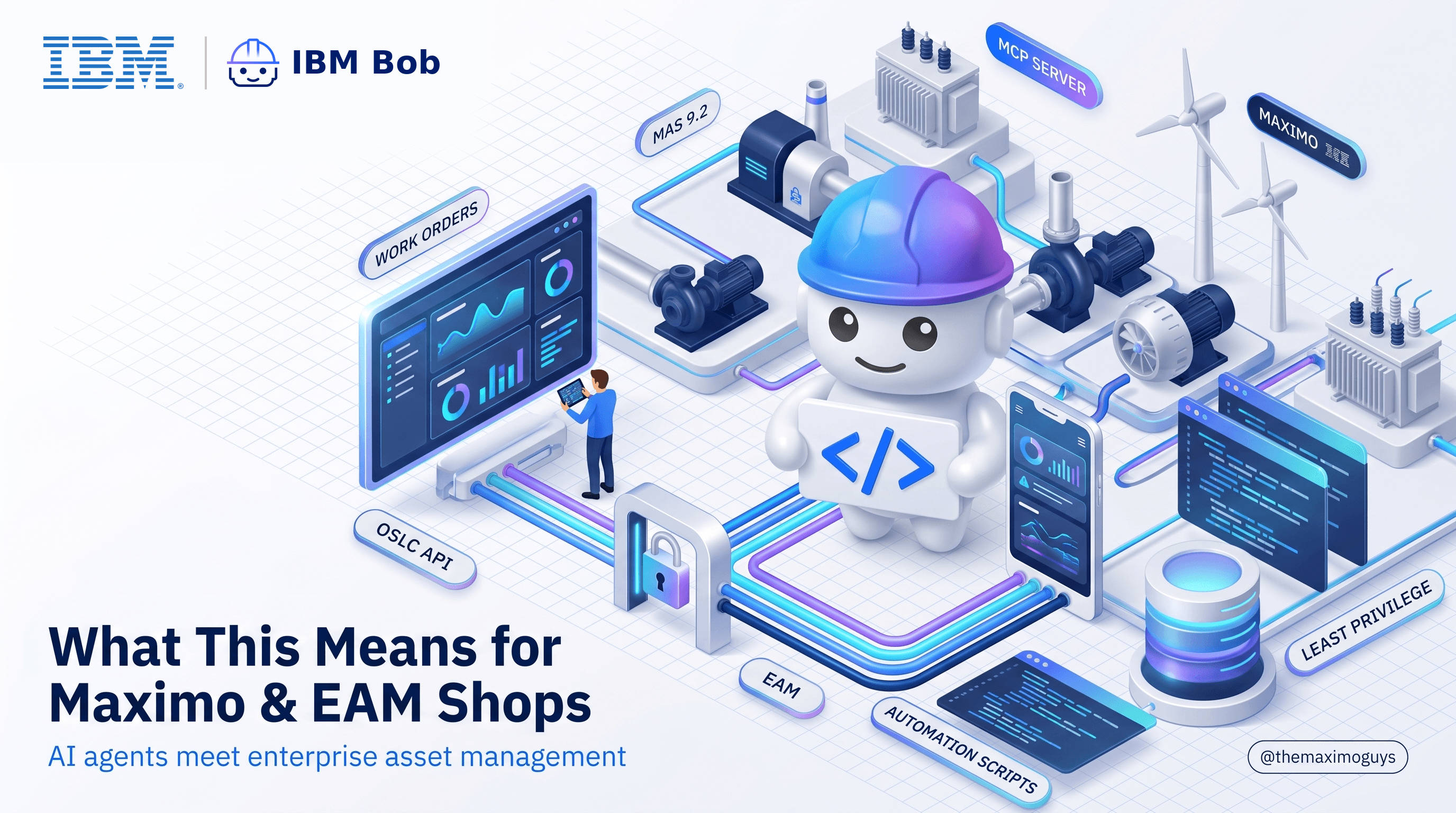
Enterprise software is following. IBM's Maximo Application Suite 9.2, for example, ships a built-in Maximo MCP server whose tools are generated from Maximo's own API specifications. On our side, TheMaximoGuys built Max_mcp, a Maximo MCP server with 175 purpose-built tools across work orders, assets, inventory, purchasing and more, which works across Maximo versions. That planner in 2026? His agent was talking to an MCP server.
💡 Key insight: An MCP server is a doorway, not a skeleton key. The agent should come through the same APIs, logins and permissions as any other application, and never write straight to the database. If a person using the agent could not do something in the application, the agent should not be able to either.
⚠️ The Honest Part
Each era widened what the AI can touch, and each widened the blast radius too. A bad autocomplete wastes ten seconds. A bad agent action can update a thousand records. In January 2026, security researchers at PromptArmor showed that a beta of IBM Bob's command-line tool could be tricked by instructions hidden in a README into downloading and running malware once one command had been auto-approved. IBM pledged fixes before general availability, but the lesson is universal: anything an agent reads, including documents and tool results, can try to steer it.
So start conservative. Give agents read-only credentials first. Require approval for any tool that changes data. Log every call. Then widen access as you build trust, the same way you would with a new hire.
Key Takeaways
- AI coding moved through three eras: finishing lines, answering questions, and now carrying out multi-step work.
- Agents are only as useful as the systems they can reach, and MCP has become the standard way in.
- Platforms like Maximo 9.2 now ship their own MCP servers, and purpose-built ones like Max_mcp add more.
- Connect agents through APIs and permissions, start read-only, and require approval before anything changes.
References
- Anthropic — Introducing the Model Context Protocol (November 2024)
- IBM Documentation — Maximo MCP server overview
- IBM Think — What is agentic coding?
- The Register — IBM Bob vulnerability research (January 2026)
- TheMaximoGuys — Max_mcp on GitHub
Series Navigation
| Previous: | Part 2 — The Prompt Is the New Spec |
|---|---|
| Next: | Part 4 — Plan Before You Vibe |
🧰 From TheMaximoGuys toolbox: Max_mcp is our Maximo MCP server, available on npm (@themaximoguys/maximo-mcp) and GitHub: 175 tools across 20 modules, with validation, rate limiting and multi-environment support. Plug it into Claude, Bob, Copilot, Cursor, or any MCP-capable agent, and start with a read-only API key.
Published by TheMaximoGuys | August 2026
 Krishna Neela
 Manasa Ganga