

Enterprise Vibe Coding: Series Index
🎯 Who this is for: Developers, team leads and executives in regulated industries who keep hearing "vibe coding" and want to know what it looks like when the stakes are payroll, power grids and policyholder data.
Series: Part 0 of 13 — Enterprise Vibe Coding | Read time: 5 minutes
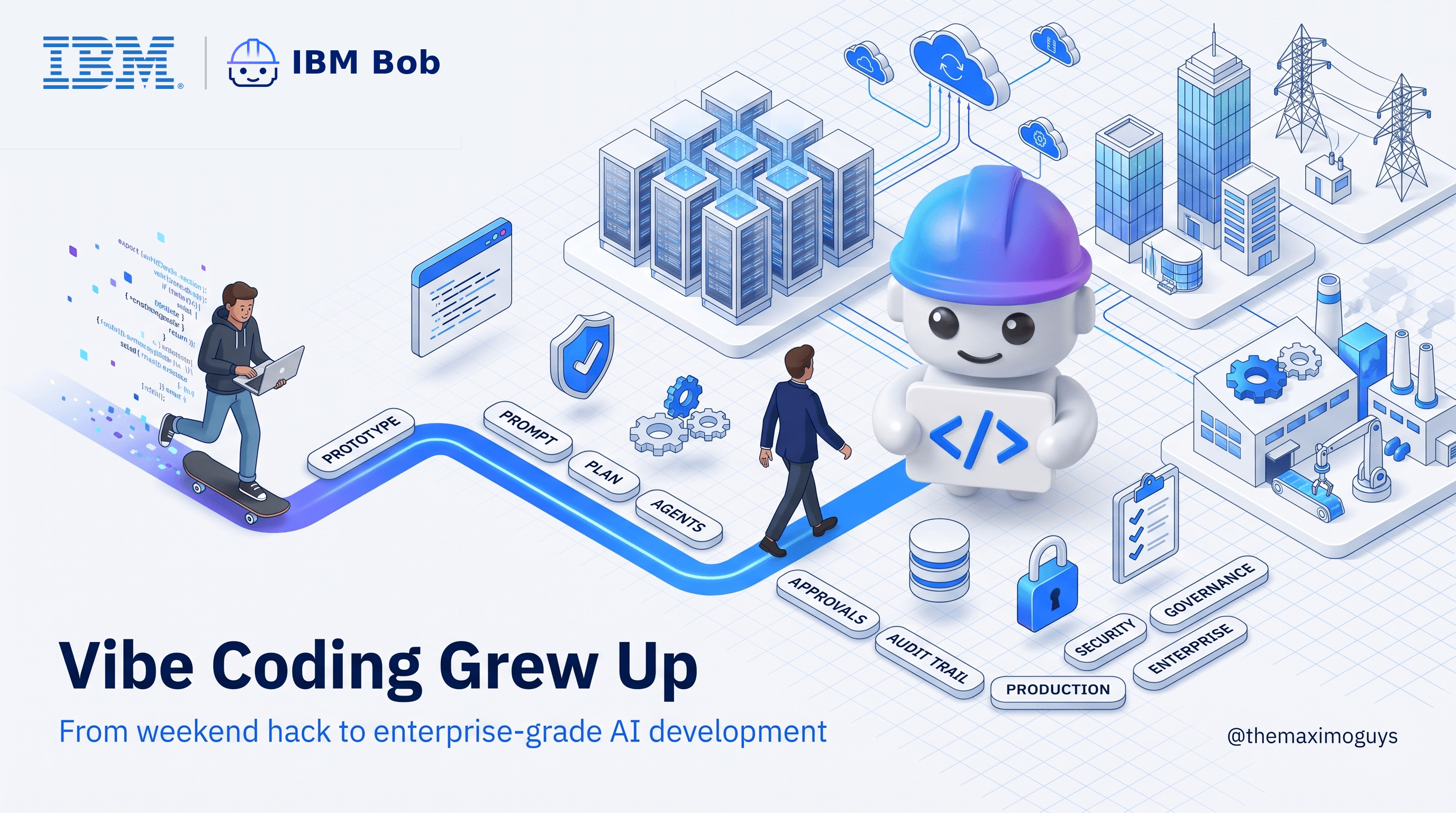
Picture two developers on the same Saturday.
The first is at her kitchen table, building a recipe app for fun. She types "make it look nicer and add a shopping list," the AI rewrites half the code, and she clicks accept without reading a line. If it breaks, she shrugs and asks again.
The second works at a regional utility. On Monday she has to change how outage credits are calculated for 400,000 customers. She would love the same speed. But her change needs a ticket, a reviewer, a test plan, and an auditor who can later ask, "Who changed this, and why?"
Both of them are vibe coding. Only one of them can afford to forget the code exists. This series is about the second developer.
🎯 Why This Series Exists
In early 2025, "vibe coding" was a joke-adjacent term for letting the AI drive. By 2026 it was a product category with enterprise price lists. GitHub Copilot, Cursor, Claude Code and Kiro all grew agent modes. IBM shipped Bob, which it pitches as an AI development partner built for enterprise teams, added European and Japanese regions in July 2026, and says an on-premises option for data-residency and regulated environments is on its roadmap.
Even the vendors can't agree on the name. IBM's own product messaging avoids "vibe coding" entirely, while the press happily calls Bob a vibe coding tool. IBM's explainers treat vibe coding as the informal end of a spectrum that runs through agentic coding to agentic engineering. Wherever you land on the label, the work is the same: AI writing a lot of the code, and humans staying accountable for it.
The tools changed faster than the playbooks. Most writing about vibe coding is either breathless ("10x everything!") or dismissive ("toy for demos"). Enterprise teams need something in between: what actually works, what the guardrails look like, and which numbers to trust.
So that is what we wrote: short posts, plain English, real examples, and one honest skeptical note in every part.
🧭 How to Read It
Each part stands alone and takes five to eight minutes. They build loosely in four arcs:
- The shift (1–3): what changed, prompts as specs, autocomplete to agents.
- The guardrails (4–5, 9, 11): planning, human approval, receipts, house rules.
- The enterprise realities (6–8, 10): legacy code, firewalls, model choice, honest numbers.
- The Maximo finale (12–13): what it means for EAM teams, plus your first Maximo AI agent.
📊 The Series at a Glance
| Part | Title | The one-line idea |
|---|---|---|
| 1 | Vibe Coding Grew Up | From weekend hack to payroll systems |
| 2 | The Prompt Is the New Spec | A vague prompt is a vague requirement |
| 3 | Autocomplete → Chat → Agents | Three eras, and MCP as the bridge to your systems |
| 4 | Plan Before You Vibe | Plan, Ask and Agent modes across tools |
| 5 | Human-in-the-Loop Is a Feature | Approvals are not friction, they are safety |
| 6 | Your Legacy Code Is AI's Best Job | COBOL, RPG and old Java, with caveats |
| 7 | Vibe Coding Behind the Firewall | Self-hosted, air-gapped, sovereign |
| 8 | One Model Doesn't Fit All | Routing, and the black-box trade-off |
| 9 | Receipts, Please | Audit trails for AI-written code |
| 10 | Reading the Productivity Numbers | 45%, 70%, 10x: what they really mean |
| 11 | Teaching the AI Your House Rules | AGENTS.md, rules, skills and MCP |
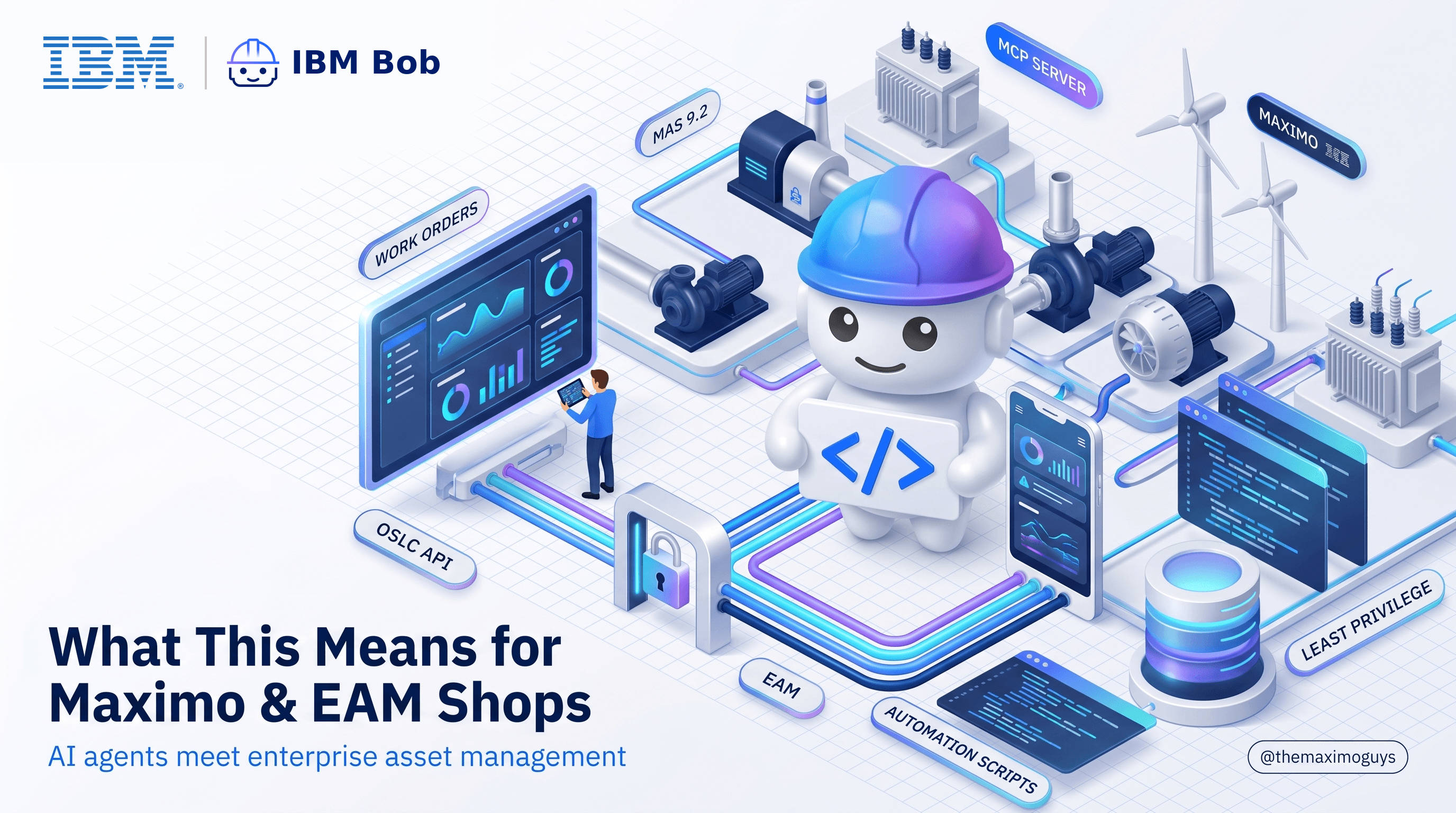
| 12 | What This Means for Maximo & EAM Shops | MCP servers, skills and Maximo 9.2 |
| 13 | Your First Maximo AI Agent in an Afternoon | Hands-on, read-only, safe |
💡 A note on numbers: You will see big figures in this series, like IBM's reported 45% average productivity gain from its own internal users. We always say who reported a number and how it was measured. When the only source is the vendor, we say so. Part 10 is entirely about reading these claims well.
🧰 The Tools You Will Meet
We do not crown a winner. Each tool shows a different enterprise answer:
- GitHub Copilot — the tool that put AI in most developers' editors first.
- Cursor — the AI-native editor many vibe coders started with.
- Claude Code — an agent that lives in your terminal and works across a whole repository.
- Kiro — Amazon's spec-driven editor that turns a prompt into requirements, design and tasks before it writes code.
- IBM Bob — IBM's enterprise-focused development partner with Plan, Ask and Agent modes, approval gates and admin analytics.
Independent analysts have been cautious, and we will be too. IDC noted at Bob's launch that the "external evidence base remains limited." That is fair for the whole category.
Where to start: new to the topic, read in order. Leading a team or budget, try Parts 1, 5, 7 and 10. Working with Maximo, read Part 3, then jump to 12 and 13.
Key Takeaways
- Vibe coding has moved from weekend experiments into regulated enterprise teams, and the tools have followed.
- The enterprise version keeps the speed but adds specs, human approvals, audit trails and control over data and models.
- We compare Copilot, Cursor, Claude Code, Kiro and IBM Bob, and label every vendor number as vendor-reported.
- Parts 12 and 13 bring everything home to Maximo and EAM teams.
References
- IBM Newsroom — Introducing IBM Bob (April 28, 2026)
- IBM — IBM Bob expands with premium packages, new architecture and greater enterprise control (July 2026)
- The Register — IBM Bob vulnerability research (January 2026)
- IBM Documentation — Maximo MCP server overview
Series Navigation
| Previous: | — |
|---|---|
| Next: | Part 1 — Vibe Coding Grew Up |
🧰 From TheMaximoGuys toolbox: If you work with Maximo, bookmark Max_Interfaces, our open-source (MIT) library of 2,439+ Maximo API endpoints. It is the map every AI agent in this series will need when it reaches for your EAM data, whether you plug in Claude, Bob, Copilot or Cursor.
Published by TheMaximoGuys | August 2026
 Krishna Neela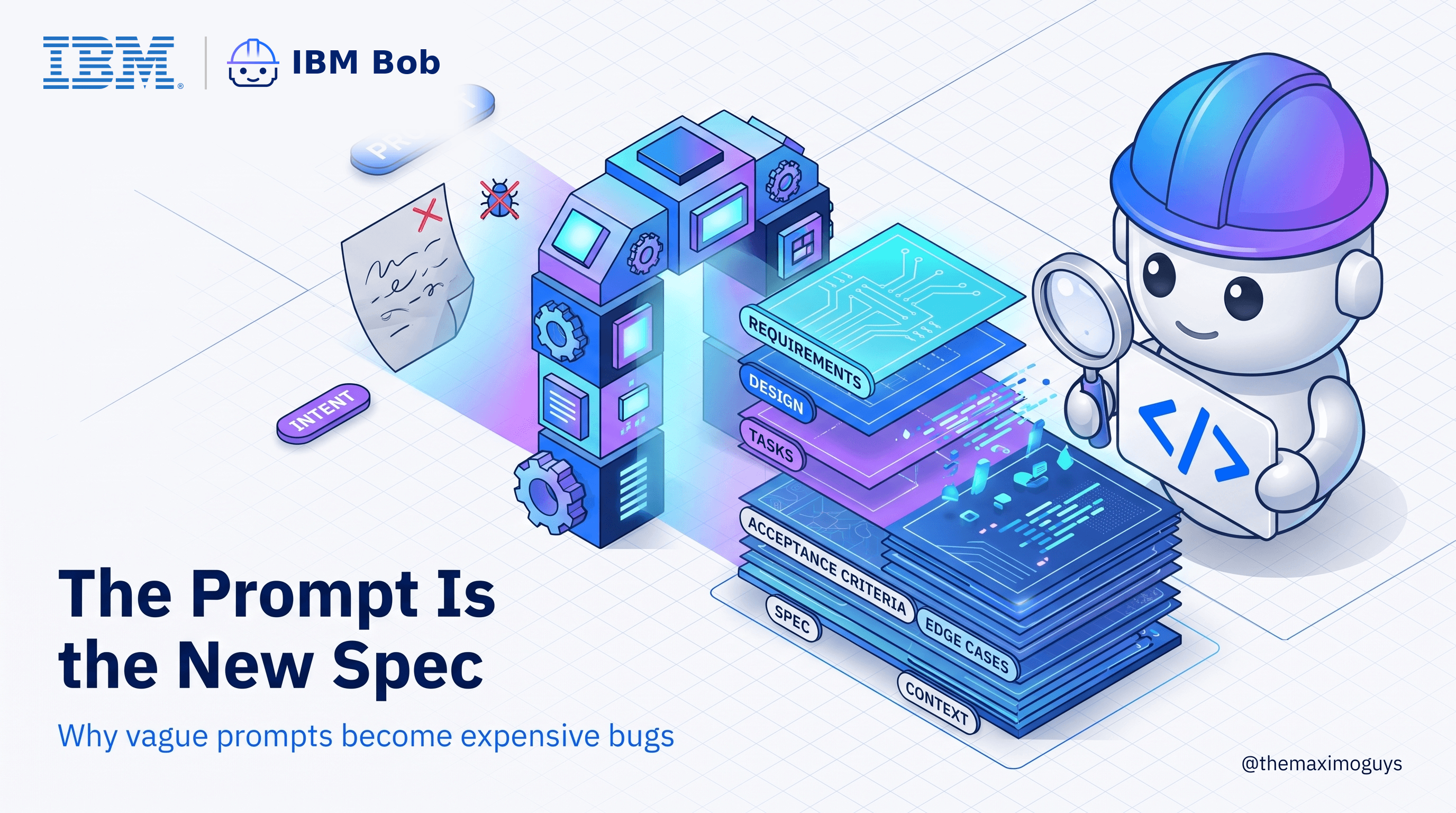
 Manasa Ganga